| A | B | C | D | E | F | G | H | I | J | K | L | |
|---|---|---|---|---|---|---|---|---|---|---|---|---|
| A | ---- | |||||||||||
| B | ---- | |||||||||||
| C | ---- | |||||||||||
| D | ---- | |||||||||||
| E | ---- | |||||||||||
| F | ---- | |||||||||||
| G | ---- | |||||||||||
| H | ---- | |||||||||||
| I | ---- | |||||||||||
| J | ---- | |||||||||||
| K | ---- | |||||||||||
| L | ---- |
Homework II: Directed Graphs
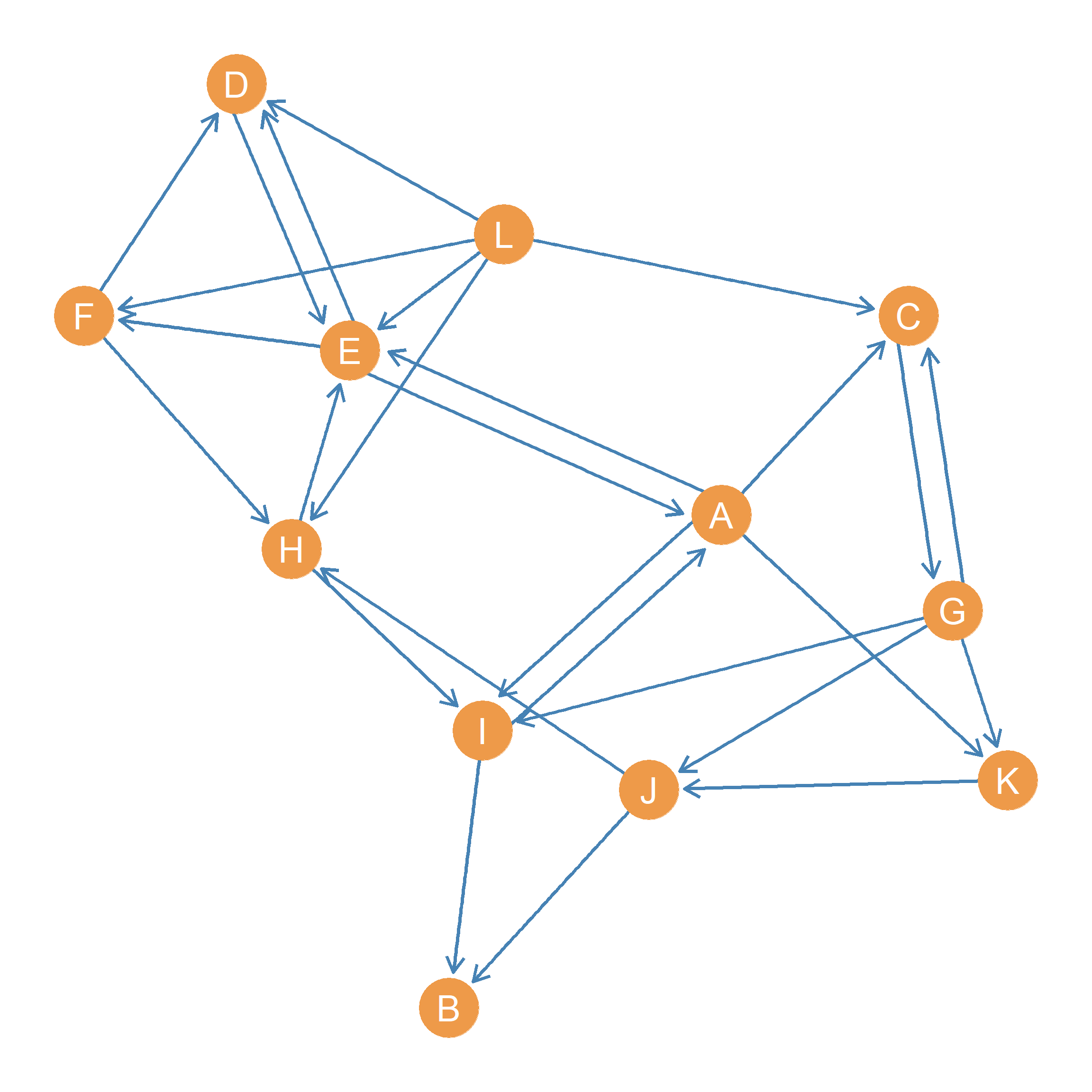
Consider the graph shown in Figure 1:
- Write down the edge set of the graph:
Directed Graph Neighborhoods
Who are the out-neighbors of node A?
Who are the in-neighbors of node E?
What is the intersection of the out-neighborhoods of nodes A and I?
What is the intersection of the in-neighborhoods of nodes H and E?
What is the union of the out-neighborhoods of nodes G and K?
What is the union of the in-neighborhoods of nodes B and I?
Directed Graph Degrees
What is the out-degree of node H?
What is the in-degree of node E?
What is(are) the node(s) with the largest out-degree?
What is(are) the node(s) with the largest in-degree?
What is(are) the node(s) with the smallest out-degree?
What is(are) the node(s) with the smallest in-degree?
Directed Graph Node Types
Which is(are) the receiver node(s) in the graph?
Which is(are) the transmitter node(s) in the graph?
Directed Graph Metrics
What is the graph’s in-degree sequence?
What is the graph’s out-degree range?
What is the graph’s in-degree range?
cWhat is the graph’s sum of degrees?
What is the size of the graph?
What is the graph’s maximum size?
Compute the density of the graph:
From Graph to Matrix
- In the matrix below, write down the cell entries for the adjacency matrix corresponding to the graph shown in Figure 1: