37 The Strength of Weak Ties
The theory of the Strength of Weak Ties, introduced by Mark Granovetter (1973), posits that weaker social connections can be more valuable than strong ties, especially for accessing novel information and opportunities. This theory is a key foundational element of social network analysis.
37.1 Defining Tie Strength
The strength of a tie is defined as a combination of four elements: (1) the amount of time spent together, (2) the emotional intensity of the relationship, (3) the level of intimacy (mutual confiding), and (4) the reciprocal services or exchanges that characterize the tie (Granovetter 1973). work.
37.1.1 Strong Ties
These ties are characterized by longevity, frequent activation, high emotional intimacy, and frequent exchanges of favors. For example, your closest kin and best friends typically form your “support clique” (around 4-5 people) and “sympathy group” (around 12-15 people), which can be classified as strong ties (see sec-dunbar), these are the people you would go to for advice in a difficult situation or ask for favors (e.g., helping you move, or helping you financially) that you wouldn’t ask of others.
Similar-race ties, kin ties, and positive-sentiment ties are likely to be strong. Strong ties are also associated with more trust, intimacy, and cooperativeness, and are more effective at transferring complex or interdependent information. They foster commonality of interests and experience through homophily (McPherson et al. 2001).
37.1.2 Weak Ties
These ties are typically characterized by having recently started, being infrequently activated, lacking emotional intimacy, and not featuring many exchanges of favors. Acquaintanceship ties and coworker ties are likely to be weak. Note that just having one of the tie strength properties, like frequent activation, isn’t enough for a tie to be strong.
For instance, you might see a coworker every weekday and even hate them, but this frequent interaction alone doesn’t make the tie strong if intimacy and exchange are low. Similarly, a former best friend from college with whom you’ve lost touch might become a weak tie if the frequency of interaction decreases, despite past intimacy and exchanges.
37.2 Marsden and Campbell’s Indicator/Predictor Model of Tie Strength
One influential approach to measuring tie strength, which distinguishes between factors that predict tie strength and indicators that show an existing tie’s strength, is proposed by Marsden and Campbell (1984). This model suggests a comprehensive approach to assessing tie strength by considering two factors: the predictors of tie strength and the indicators of tie strength.
Predictors.- These are factors that influence whether a strong tie is more or less likely to form. Examples include:
- Role relations: Such as being friends or co-workers.
- Similarities: Common memberships (foci), shared social positions, or socio-demographic and cultural similarities. For instance, people who are similar are often more likely to form strong ties.
Indicators.- These are characteristics that tell us how strong an existing tie is. They often reflect the intensity and nature of the interaction as described earlier.
- Closeness/Intimacy (Sentiments): The degree of mutual confiding or emotional intensity. Subjective closeness is considered the most reliable indicator of tie strength.
- Frequency of Interaction: How often individuals interact.
- Duration: How long the relationship has lasted.
- Exchange/Support: The reciprocal services, resources, or information exchanged.
The Marsden and Campbell model recommends combining these different criteria rather than relying on single proxies for strength, such as only role relations or interaction frequencies, which can have limitations. For example, “family” or “friends” are often considered strong ties, but acquaintances, co-workers, and neighbors might be weak ties.
Similarly, frequent interaction is often associated with strong ties, whereas infrequent interaction is associated with weak ties. However, as already noted, simply having one property (like frequent activation) is not enough to classify a tie as strong. There is a positive correlation between a tie’s type (e.g., similarity, kin, positive sentiment) and its strength, but it’s not a strict rule.
Tie strength is a crucial measure for ego networks. Researchers often use indicators like closeness/intimacy, frequency of interaction, duration, and exchange/support to assess the strength of an existing tie. Predictors of tie strength include role relations (e.g., friend, coworker) and common memberships/social position.
37.3 Granovetter-Transitivity (g-transitivity)
Granovetter’s theory builds upon the concept of g-transitivity. We can derive two main interaction rules from this idea, which apply to triads (sets of three people):
- Rule 1: If two people (A and B) are strongly connected, they are likely to have a lot of other friends in common. This means the subgraph of an ego’s strongly tied neighbors tends to have a high density of connections.
- Rule 2: If person A has a strong tie with B, and B has a strong tie with C, then there should be at least a weak tie between A and C. In other words, if A is strongly connected to B and B is strongly connected to C, this suggests a good probability of an existing tie between A and C.
Reasons for g-transitivity include demographic similarity (homophily), shared social foci (e.g., participation in common activities or membership in the same groups), and propinquity (physical proximity). Homophily, the tendency for people to connect with similar others, is a well-established finding in the social sciences and can lead to more durable relationships. Shared social foci, where actors participate in common activities, are a mechanism for context-driven link formation.
37.4 The Weak Tie Principle
A central tenet of the strength of weak ties theory is Granovetter’s weak tie principle, which states that weak ties allow violations of g-transitivity. This means that you do not necessarily have to be connected to every person who is connected to someone with whom you only have a weak tie. In ego networks, weak ties in an individual’s “active network” (Dunbar 2014) are less likely to be connected to one another, leading to violations of g-transitivity.
37.5 Weak Ties as Bridges
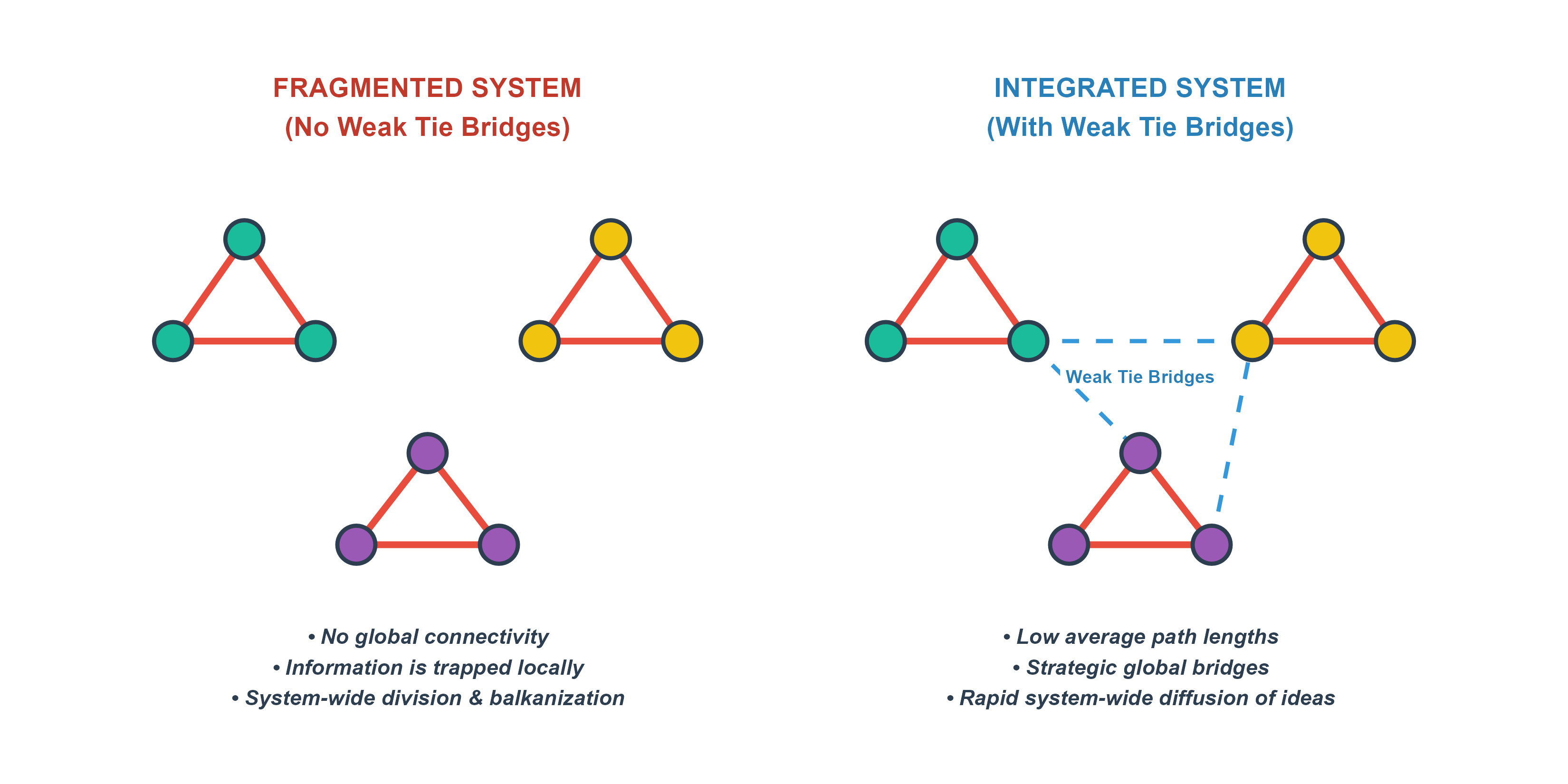
The most significant insight of the theory is that weak ties frequently function as bridges, connecting an individual to parts of the social structure that they would not otherwise have access to through their strong ties. Particularly, weak ties allow the individual to access novel Information. Strong ties, due to g-transitivity, often lead to redundant information because “a friend of a friend is (likely to be) a friend”.
The aforementioned implies that your close friends are likely to know the same information or have similar perspectives. Weak ties, however, provide access to novel and valuable information that your close friends might not possess. These bridging ties connect parts of the network that would otherwise be disconnected, significantly reducing the average shortest-path length in the graph and enabling rapid information transmission.
In this respect, the absence of weak ties implies several disadvantages:
- An individual will not have access to distant parts of the social system.
- Information tends to be localized.
- One is put at a disadvantage when novel information is valuable.
- At a broader social system level, an absence of weak ties can lead to fragmentation into disconnected communities characterized by strong tie clusters, making the diffusion of new ideas and global coordination difficult (as illustrated in Figure fig-swt-system-consequences).
37.6 Applications and Examples
The Strength of Weak Ties theory has implications for explaining various social phenomena:
- Social Mobility and Job Opportunities: Finding new job opportunities and achieving social mobility often depends on accessing new information. Contacts with whom you are weakly connected are more likely to know something you don’t, making weak ties valuable for uncovering new information and resources. For instance, research suggests that individuals engaging in a wide variety of cultural activities are more likely to find jobs through social contacts, particularly weak ties.
- Diffusion of Innovations: Weak ties are crucial for the rapid diffusion of certain types of information, such as gossip or disease (mainly via simplex contagion; see sec-diffusion), across networks because they reduce average path lengths between disparate groups. Early adopters of innovations often acquire new ideas from media or weak ties, reflecting a “Local/Cosmopolitan split”. Cosmopolitan innovators, in particular, are early adopters relative to the system and have very low adoption thresholds due to their diverse weak ties.
37.7 A Modern Causal Test: The LinkedIn Experiment
Despite fifty years of empirical influence, classical tests of the Strength of Weak Ties theory were historically correlational. Correlational studies are subject to selection bias (e.g., highly skilled individuals naturally possess more weak ties, confounding the link between tie weakness and job placement).
To address these challenges, Rajkumar et al. (2022) conducted a massive, five-year randomized experiment (2015–2019) on LinkedIn, the world’s largest professional network, spanning over 20 million members, creating 2 billion new connections, and recording 600,000 job transitions.
37.7.1 Experimental Design & Causal Method
The study exogenously randomized the connection recommendations that users saw in their “People You May Know” (PYMK) feed. Some users were algorithmically recommended weak ties (alters with whom they shared very few mutual connections), while others were recommended strong ties (alters with many mutual connections). By tracking these randomized groups over time, the researchers could measure the true causal impact of weak vs. strong ties on subsequent job transmissions.
37.7.2 Operationalizing Digital Tie Strength
The study measured tie strength using two distinct digital dimensions, each revealing essential nuances and revising classical theory:
Structural Tie Strength (Neighborhood Overlap): This represents the proportion of mutual connections between two users. It was mathematically defined bidirectionally as: \(\text{StructuralTieStrength}_{ij} = \frac{M_{ij}}{D_i + D_j - M_{ij} - 2}\) where \(M_{ij}\) is the number of mutual connections between users \(i\) and \(j\), and \(D_i\), \(D_j\) are the total connections of members \(i\) and \(j\) respectively.
Interactional Tie Strength (Message Intensity): This represents the behavioral intensity of communication, measured by the volume of bilateral direct messages exchanged between two members.
37.7.3 Core Findings & Theoretical Revisions
The experimental results resolved the “paradox of weak ties” (where simple correlations mistakenly suggested strong ties were more helpful due to selection bias) and offered three key revisions to Granovetter’s theory:
- Nonlinear Structural Effects (Inverted U-Shape): Causal analysis found an inverted U-shaped relationship between structural tie strength (mutual connections) and job transmission. At low levels, adding ties with more mutual connections increased the probability of job transmission up to a point, after which there were diminishing marginal returns. The most effective structural ties are moderately weak (~10 mutual connections). True strangers (0–1 mutuals) lack the trust or motivation to assist in the hiring process, while very close ties (many mutuals) possess redundant information.
- Linear Interactional Effects: When measuring tie strength via messaging intensity, the causal test yielded a linear negative relationship. The ties with the absolute lowest messaging frequency (the weakest active ties) delivered the highest number of job transmissions.
- Industry Heterogeneity (Digital vs. Traditional): The causal power of weak ties is highly contingent on the industry’s level of digitization. In high-tech, digitally intense sectors (such as IT, software, AI/ML, and remote work), weak ties significantly outperform strong ties due to the rapid rate of sector change and the value of highly dispersed, diverse global information. Conversely, in traditional, less-digital sectors (such as construction, agriculture, and hospitality), strong ties outperform weak ties, as hiring and mobility in these industries rely heavily on local, high-trust referral networks and offline relationships.
37.8 The Diversity-Bandwidth Tradeoff Theory
Aral and Van Alstyne’s Diversity-Bandwidth Tradeoff Theory (Aral and Van Alstyne 2011) extends Granovetter’s original argument by incorporating the temporal flow of information. While Granovetter’s initial conception viewed tie properties in static terms, information transmission and access are dynamic processes.
The bandwidth of a tie refers to the rate at which information is transmitted. Weak ties typically transmit information at slower rates (less frequency), while strong ties transmit at higher rates (more frequency). The Diversity-Bandwidth Tradeoff Theory posits a fundamental tradeoff between the novelty/diversity of the information obtained and the “bandwidth” of the tie.
- Low Bandwidth (Weak) Ties are more effective when contacts possess diverse pools of information (different people know different things). They are particularly well-suited for transmitting novel yet “simple” information, such as “Who’s hiring?” or “What’s the best messaging app?”
- High Bandwidth (Strong) Ties excel at transmitting novel but complex or interdependent information, such as “How to do network analysis in R”. High bandwidth ties offer more trust, intimacy, and cooperativeness, facilitate a better collective memory, and are more effective at creating new knowledge by bringing people together.
The advantage of low bandwidth ties diminishes if contacts provide homogeneous information or if there’s significant overlap in information across contacts because they talk to one another. Strong, high-bandwidth ties become redundant in such cases, as they simply provide the same information more quickly. Low-bandwidth ties are preferable only when the information is relatively static, and the contacts provide highly diverse knowledge.
The Diversity-Bandwidth Tradeoff Theory, a revision of Granovetter’s Strength of Weak Ties theory, suggests that channel bandwidth is positively associated with receiving more diverse and total non-redundant information. A broader topic space and a higher refresh rate also contribute to a more valuable channel bandwidth for accessing novel information.
In summary, the Strength of Weak Ties theory highlights how seemingly less significant connections play a vital role in connecting disparate parts of a social network, facilitating the flow of diverse information, and providing unique opportunities that stronger, more redundant ties cannot offer.