41 Triadic Balance
41.1 The High School Cafeteria Dilemma
Imagine you are walking into the school cafeteria. You see your best friend, Alex. Naturally, you want to sit with them. But sitting next to Alex is Jordan. You and Jordan have a long history of not getting along. Suddenly, you feel an uncomfortable tension. Do you sit down and endure Jordan’s company for Alex’s sake, do you ask Alex to leave Jordan behind, or do you decide to eat elsewhere?
This uncomfortable scenario can be understood according to the principles of Triadic Balance Theory. At its core, this theory explains how we navigate the social world by examining networks of three entities (called “triads”; see the discussion in sec-motifs) and the positive and negative links that compose them. Triadic Balance Theory is therefore a social psychological framework that aims to explain the anticipated configurations of positive and negative ties within sentiment networks, extending Heider’s (1946) concept of dyadic balance (covered in sec-dbalance) to include a third party.
Because Balance Theory is a social-psychological theory, sentiment networks are built from valenced ties built from affects and cognitions directed at particular objects (for a refresher on different types of ties in networks see sec-ties). For instance, these ties can be positive (e.g., liking) or negative (e.g., disliking).
Triadic balance theory states that unbalanced configurations within a triad (which, as we saw in sec-triads, is typically three-person configuration) consisting of P, an object O, and a third party Q produce “tension” for the focal node (P). This tension creates a psychological drive for these configurations to transition towards balanced ones, either on the part of P or the others. Meanwhile, when a triad is balanced the triple of sentiment relations in the ties is in harmony and nobody experiences tension, which means that the triad is likely to persist in that balanced style for the foreseeable future.
41.2 The key principles of Triadic Balance Theory
Balance theory uses four basic graph-theoretic concepts to analyze triadic configurations:
- You (P): The focal individual (the reader) from whose perspective the triad is analyzed.
- An other (O): Another person towards whom you (P) hold a sentiment (a directed asymmetric tie from P to O), which can be either positive or negative.
- A third party (Q): A person or object towards whom both you (P) and the other (O) hold some sentiment (directed asymmetric ties from P to Q and from O to Q).
- Directed, Signed Edges: These indicate positive or negative sentiments that you (P) and the other (O) have towards the third party Q, you (P) towards O, and your perception of the link between O and Q. For instance, “you (P) like O” is represented as a directed edge with a positive sign going from P to O. In contrast, “O hates Q” is represented by a directed edge going from O to Q with a negative sign.
Q does not necessarily have to be a real person; it can be any object, such as an organization, a collective, a cultural object, or even an idea. For instance, if Jordan likes The Avengers: Age of Ultron (a positive sentiment tie from O to Q) but you think that the movie is a complete mess (a negative sentiment tie from P to Q) then tension will be experienced as long as you and Jordan are still friends (a positive sentiment tie from P to O), because the combination of two positive links and a negative link creates an unbalanced configuration as we will see in a bit.
41.3 Balanced vs. Unbalanced Configurations:
As we have already noted, triadic balance theory distinguishes between balanced and unbalanced triadic configurations. Let’s see what mean by these two terms in more detail.
41.3.1 Balanced Triads
Balanced triadic configurations are characterized by harmonious and stable sentiments, creating no “tension” within the triad. These configurations follow a mathematical rule where multiplying the signs of the edges (positive ties as +1, negative ties as -1) results in a positive number (+1). A simpler rule for identification is that a triad is balanced if it has either zero or two negative links.
Here are some concrete examples of balanced triadic configurations:
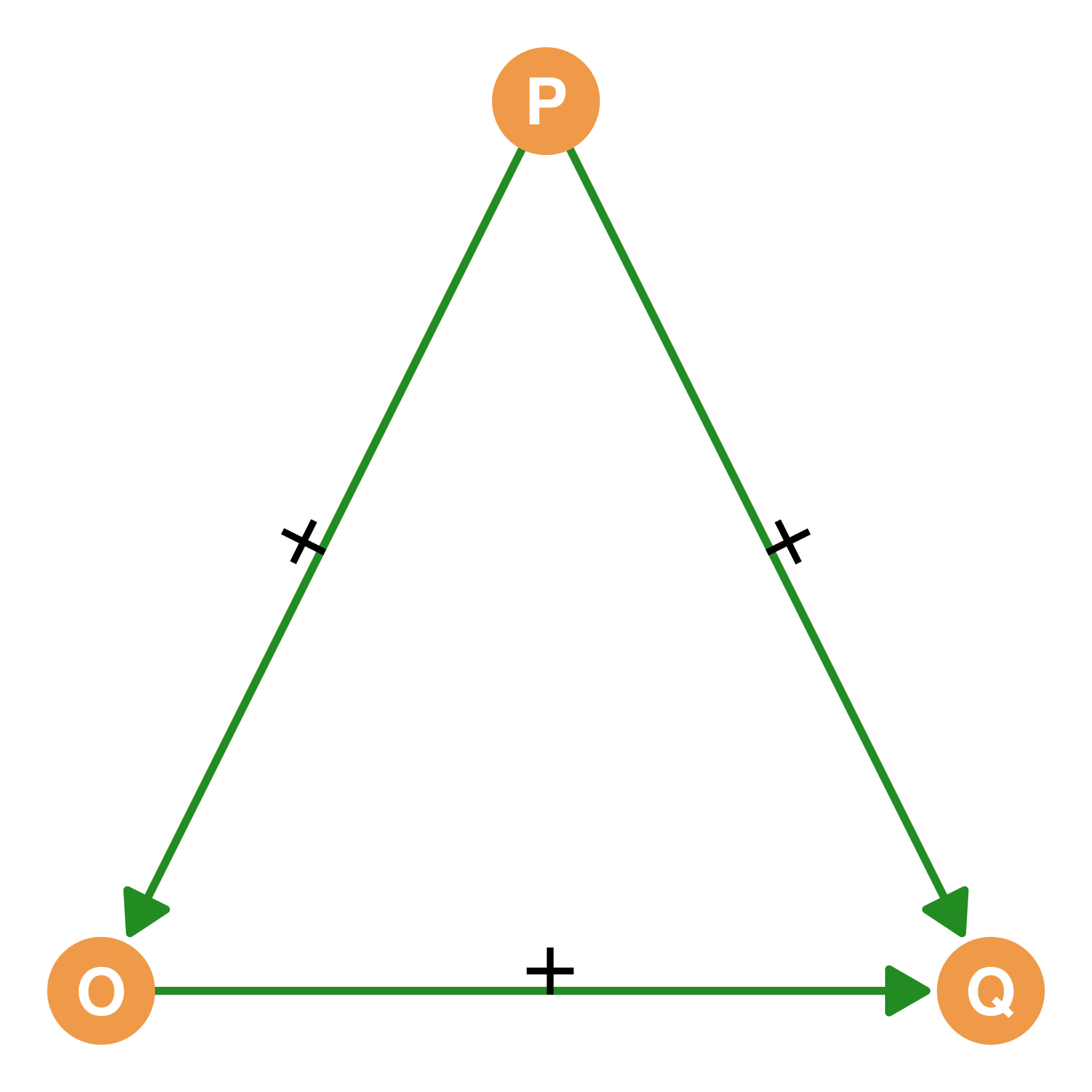
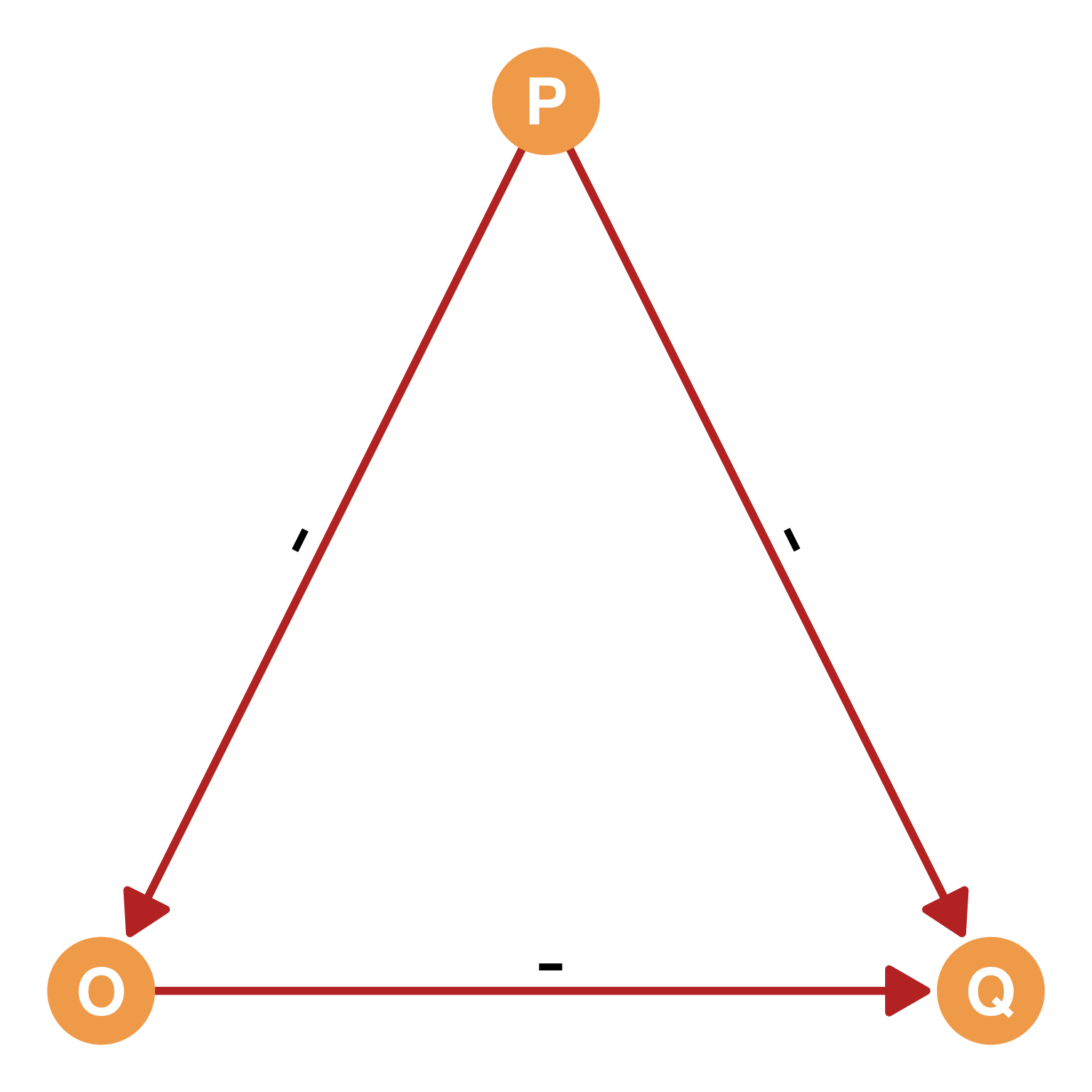
“A friend of a friend is a friend” (depicted in Figure fig-balanced-1): In this configuration, you (P) like another person (O) (positive tie, +1), that person (O) likes a third party (Q) (positive tie, +1), and you (P) also like that third party (Q) (positive tie, +1). For example, imagine that you (P) have a friend (O) whom you like, and they like another classmate (Q) whom you also like. Everything is harmonious because all sentiments are positive. Mathematically, multiplying the edge signs yields a positive result, \((+1) \times (+1) \times (+1) = +1\), corresponding to a sign pattern of P-O (+), O-Q (+), and P-Q (+). With zero negative links, this triad is perfectly balanced and stable.
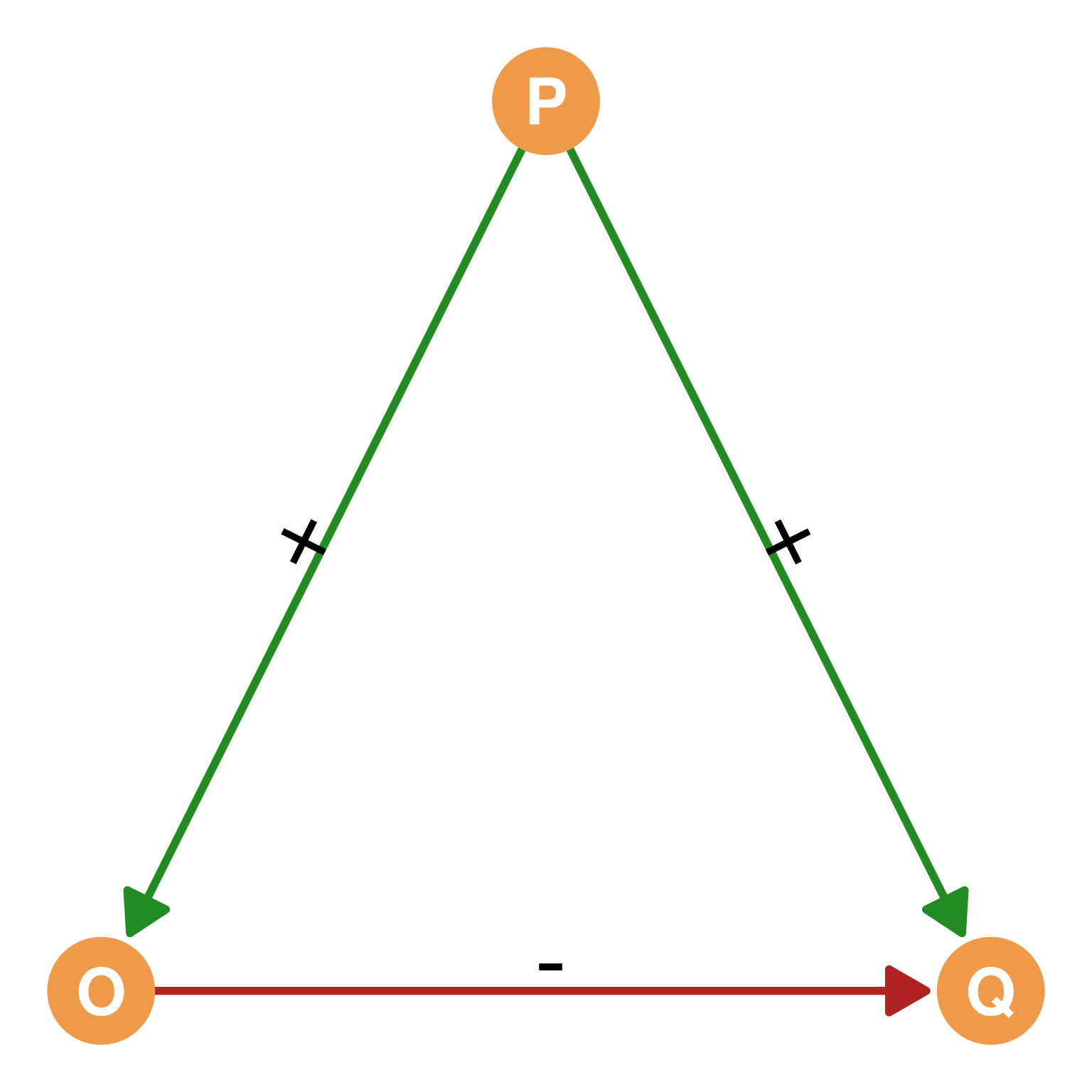
“An enemy of an enemy is a friend” (depicted in Figure fig-balanced-2): Here, you (P) dislike another person (O) (negative tie, -1) and that person (O) dislikes a third party (Q) (negative tie, -1), but you (P) like that third party (Q) (positive tie, +1). For example, if you (P) have a rival (O) who dislikes another classmate (Q), it makes social sense for you to extend a positive sentiment to your rival’s rival. This dynamic allows you and the third party to form a natural alliance. Because there are two negative links, the multiplication of edge signs remains positive, \((-1) \times (-1) \times (+1) = +1\), corresponding to a sign pattern of P-O (-), O-Q (-), and P-Q (+). Since it has an even number of negative links, this configuration is balanced and free of tension.
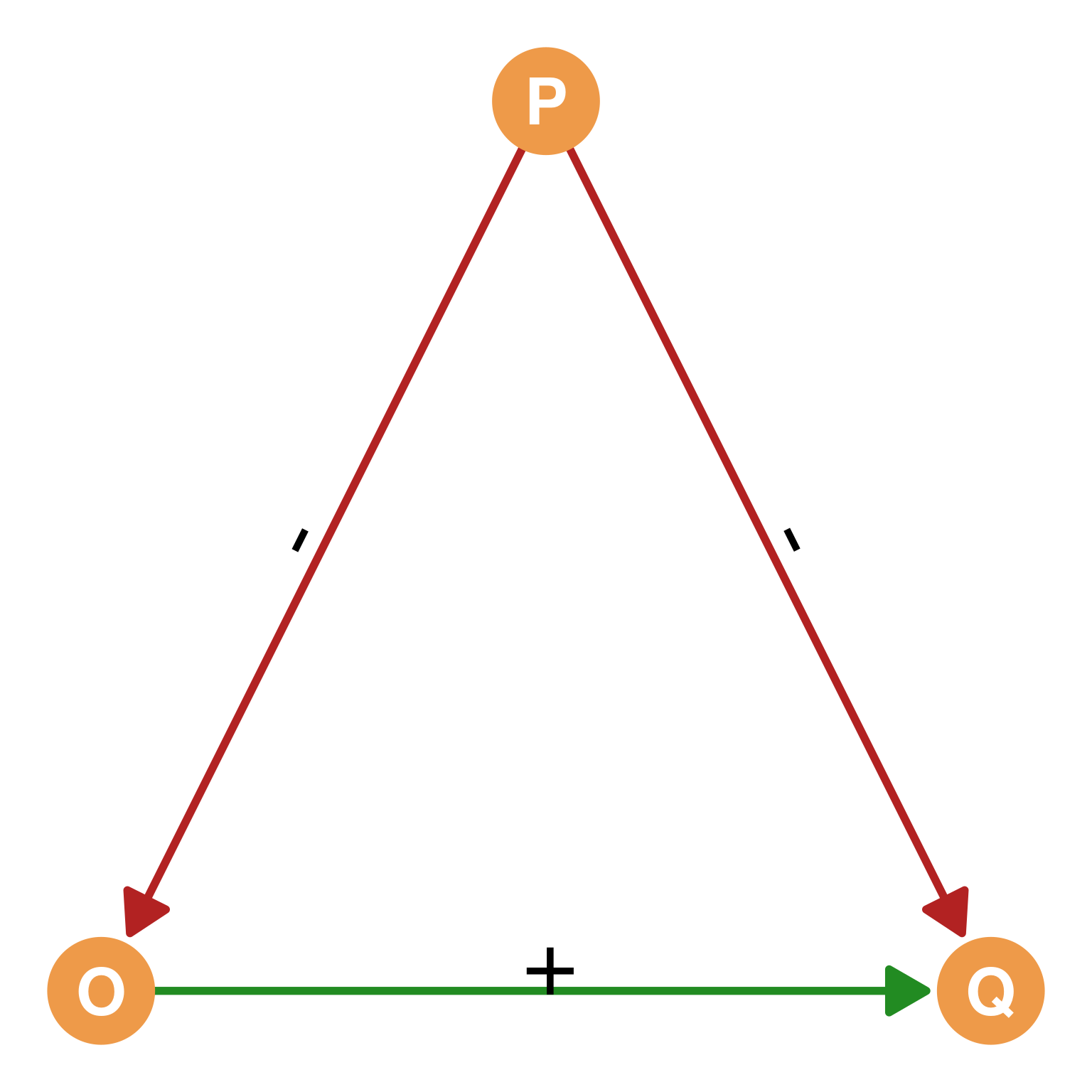
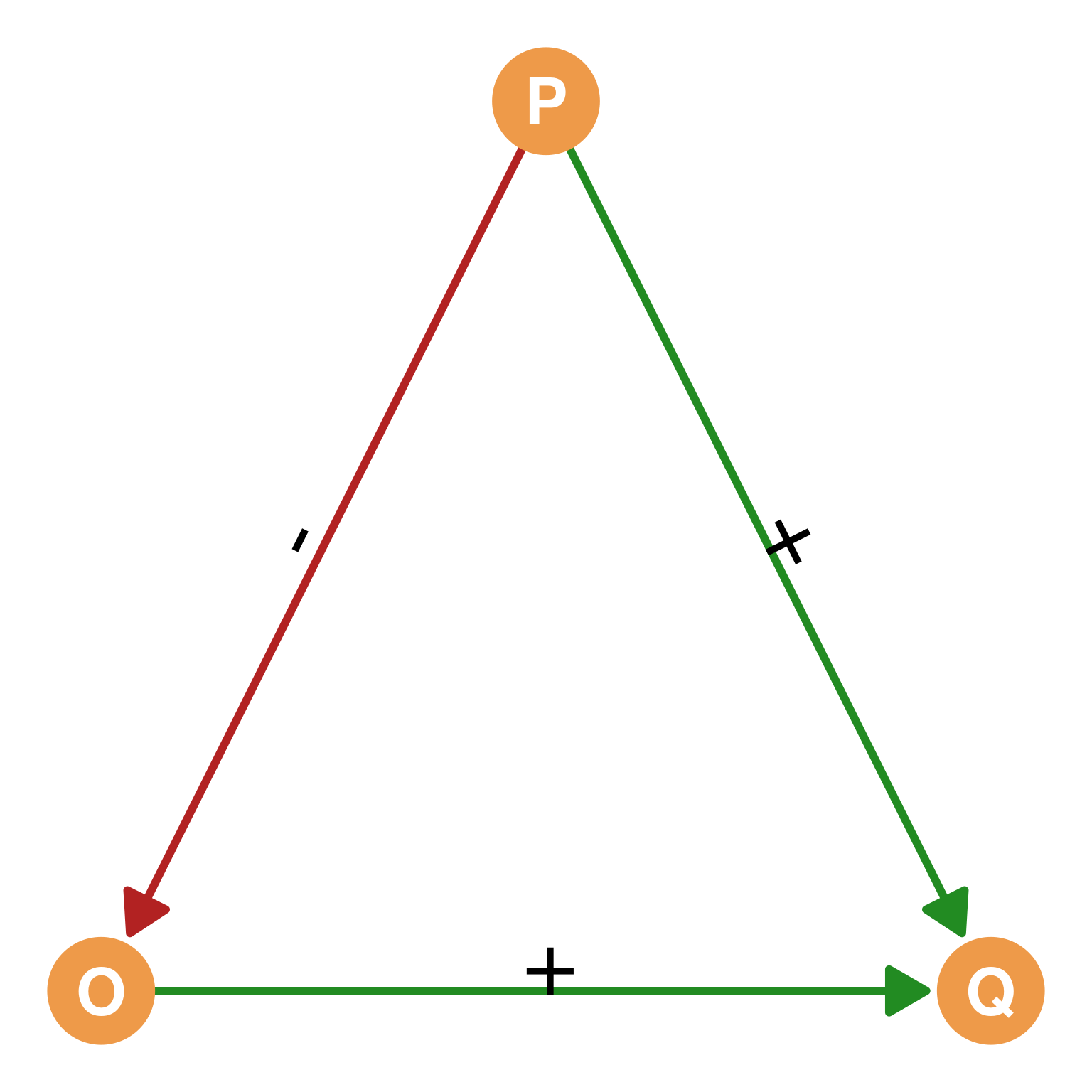
“A friend of an enemy is an enemy” (depicted in Figure fig-balanced-3): In this scenario, you (P) dislike another person (O) (negative tie, -1) and that person (O) likes a third party (Q) (positive tie, +1), leading you (P) to dislike Q (negative tie, -1). For example, imagine that you (P) have a huge fight with someone (O) and later discover they have a best friend (Q). It is psychologically consistent and natural that you would start to dislike Q as well, since they are closely aligned with your new enemy. Mathematically, this sentiment structure is balanced because multiplying the edge signs yields a positive result, \((-1) \times (+1) \times (-1) = +1\), corresponding to a sign pattern of P-O (-), O-Q (+), and P-Q (-). With exactly two negative links, the triad achieves stable equilibrium.1
1 Cardi B refers to this triad in Like What (Freestyle) where two women who direct negative ties toward her develop a positive tie towards one another (see if you can find the reference here; content warning: filthy lyrics).
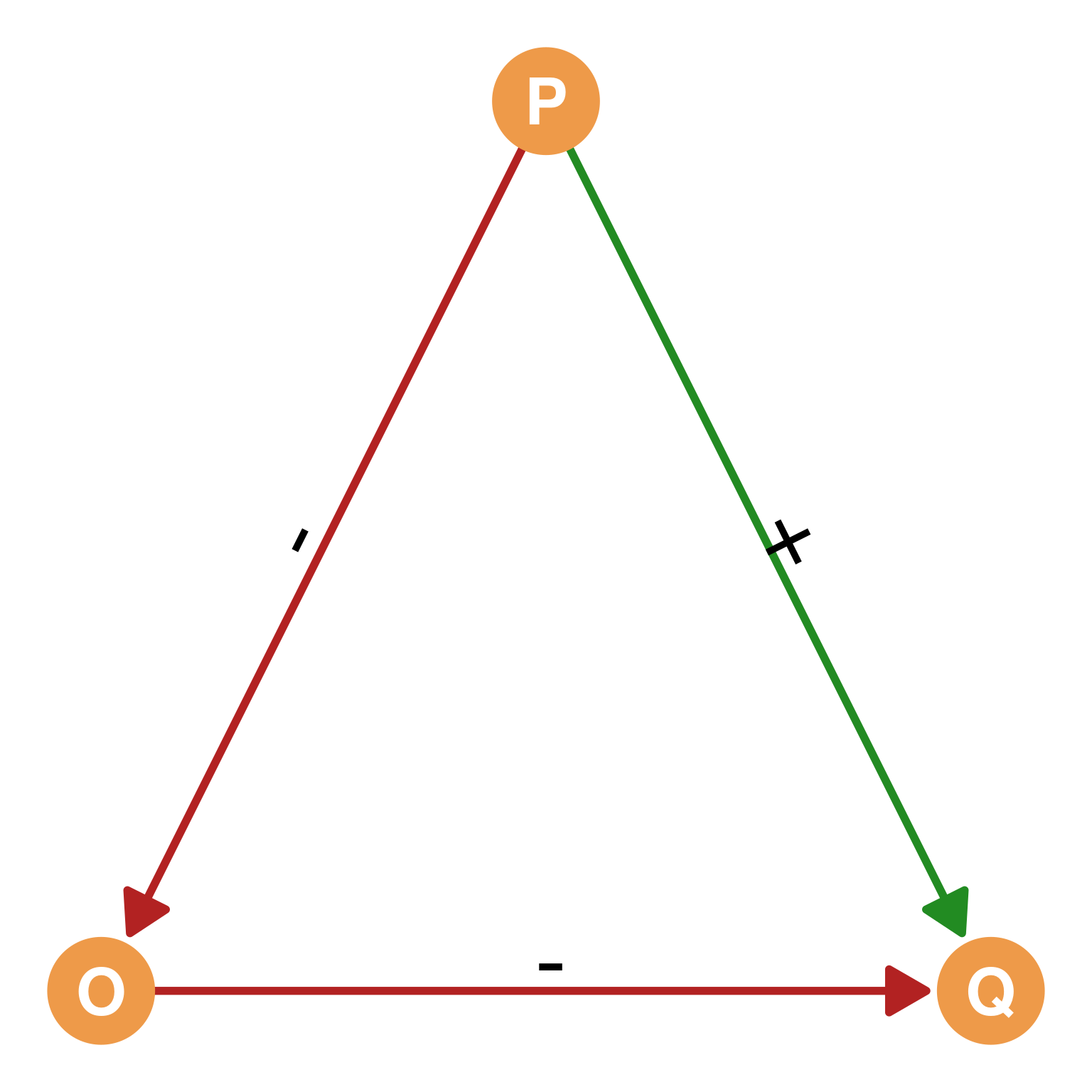
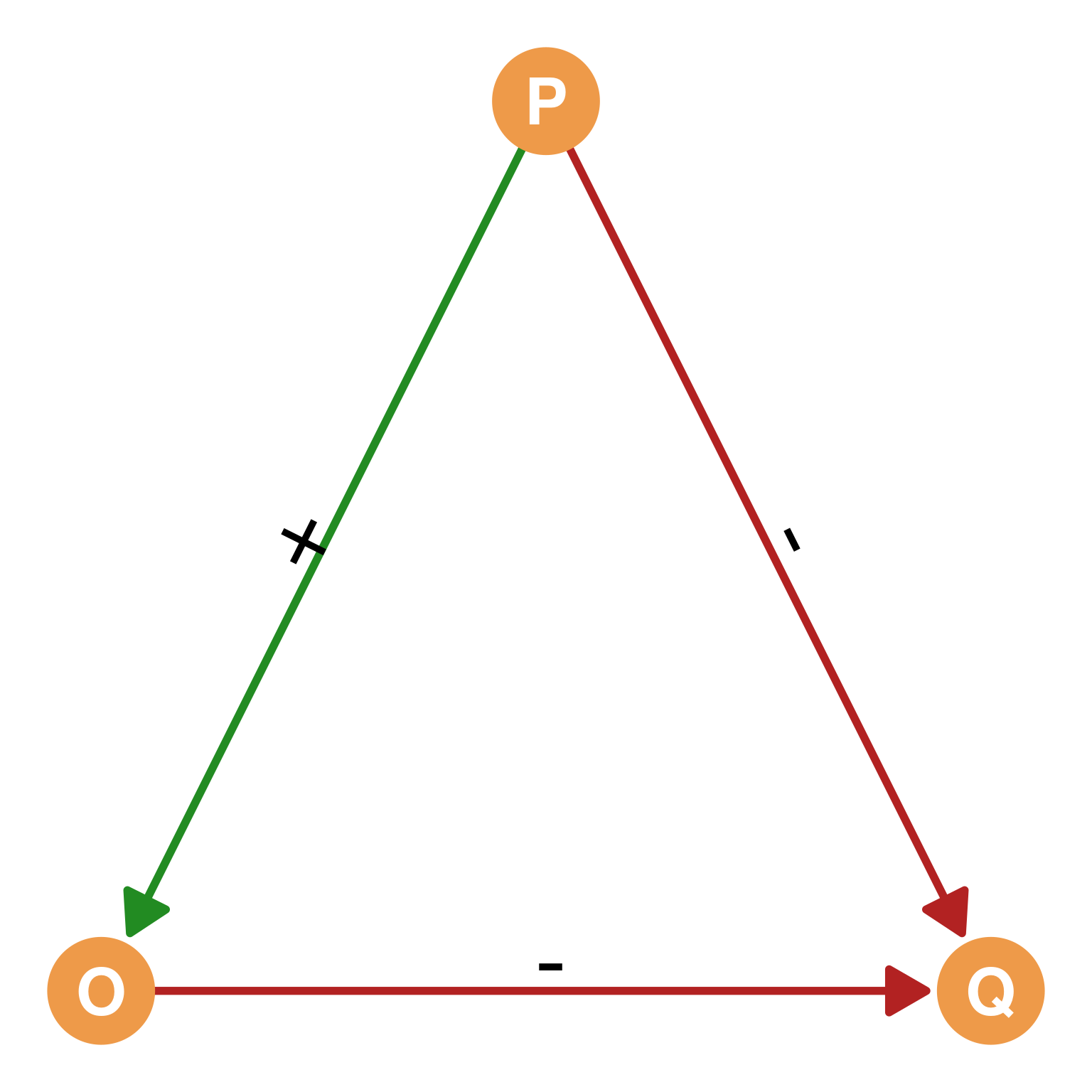
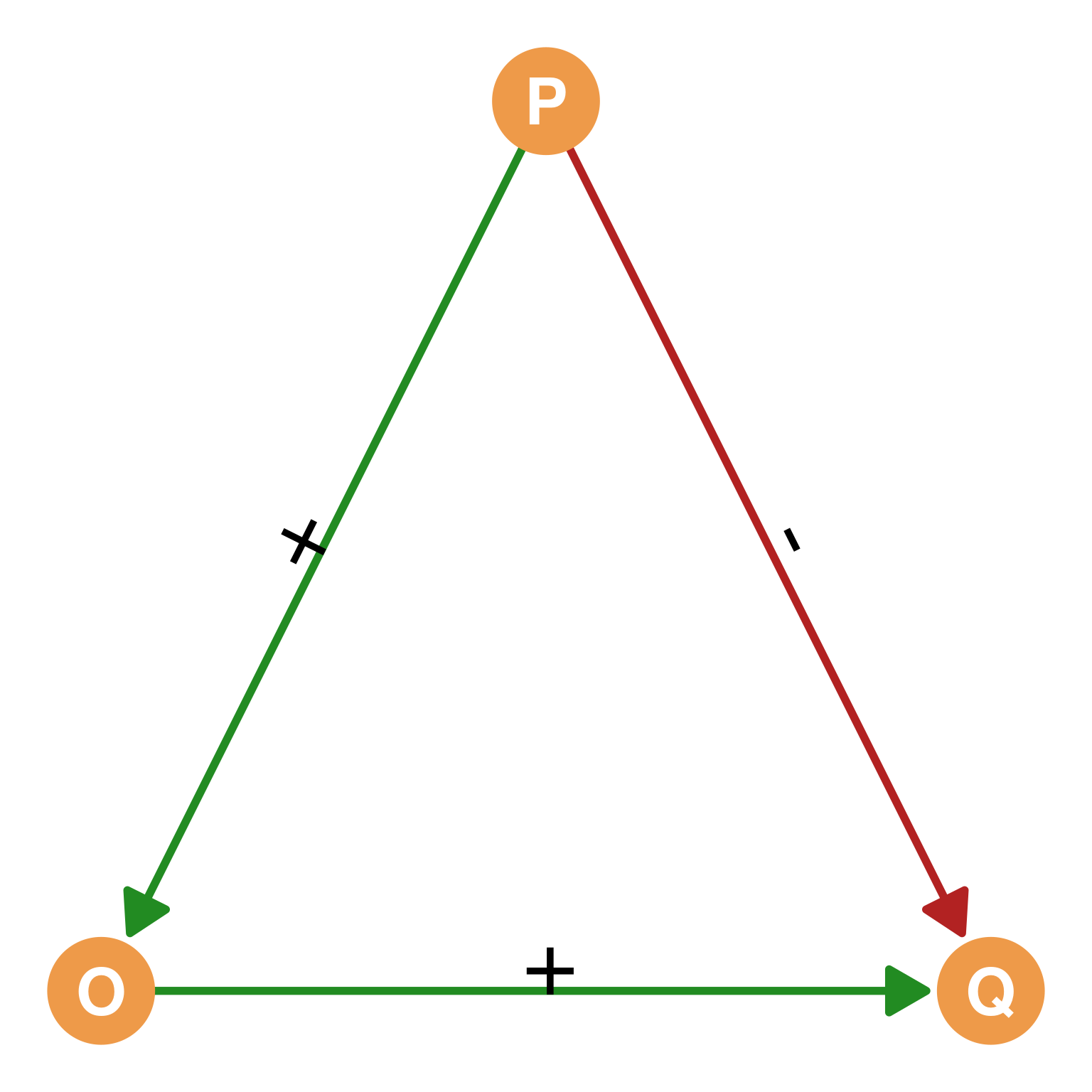
“An enemy of a friend is an enemy” (depicted in Figure fig-balanced-4): If you (P) like another person (O) (positive tie, +1) and that person (O) dislikes a third party (Q) (negative tie, -1), then you (P) must dislike Q (negative tie, -1) to maintain balance. For example, imagine you (P) have a close friend (O) who dislikes a classmate (Q). To maintain harmony in your friendship and avoid awkward social interactions, you naturally find yourself disliking Q as well. Mathematically, this relation is balanced as the product of the edge signs is positive, \((+1) \times (-1) \times (-1) = +1\), with a sign pattern of P-O (+), O-Q (-), and P-Q (-). Containing two negative links, this configuration remains balanced and stable.
41.3.2 Unbalanced Triads
Unbalanced triadic configurations in Balance Theory are those that create “tension” and are considered unstable. The theory states that these unbalanced triads will tend to transition to balanced configurations as you (P) change your sentiments toward the other (O) or the third party (Q) to alleviate this tension. Mathematically, if you multiply the signs of the edges of an unbalanced triad, the result is a negative number (-1). A simpler rule is that a triad is unbalanced if it has an odd number of negative links (one or three).
Here are some concrete examples of unbalanced triadic configurations:
“A friend of my friend is my enemy” (depicted in Figure fig-unbalanced-1): In this configuration, you (P) like another person (O) (positive tie, +1) and that person (O) likes a third party (Q) (positive tie, +1), but you (P) dislike that third party (Q) (negative tie, -1). For example, you (P) have a friend (O) whom you like, and they like another classmate (Q) whom you dislike. This situation creates psychological tension for you because of the conflicting sentiment you have towards your friend and their friend’s friend. Mathematically, the product of the edge signs is negative, \((+1) \times (+1) \times (-1) = -1\), representing a sign pattern of P-O (+), O-Q (+), and P-Q (-). Because it contains exactly one negative link, the triad is unbalanced and unstable.
“An enemy of a friend is a friend” (depicted in Figure fig-unbalanced-2): Here, you (P) like another person (O) (positive tie, +1), that person (O) dislikes a third party (Q) (negative tie, -1), but you (P) like that third party (Q) (positive tie, +1). As a concrete example, you (P) might love The Secret Lives of Mormon Wives (Q), but your partner (O), whom you like, absolutely hates them. This configuration leads to triadic tension due to the conflicting sentiments you (P) and your partner (O) hold toward the third party Q. The mathematical product of the edge signs is negative, \((+1) \times (-1) \times (+1) = -1\), with a sign pattern of P-O (+), O-Q (-), and P-Q (+). With exactly one negative tie, this is an unstable and unbalanced triad.
“A friend of an enemy is a friend” (depicted in Figure fig-unbalanced-3): In this configuration, you (P) dislike another person (O) (negative tie, -1) and that person (O) likes a third party (Q) (positive tie, +1), but you (P) also like that third party (Q) (positive tie, +1). Imagine (the horror) that you (P) and your archnemesis (O) are both attracted to or want to be friends with the same person (Q). This scenario creates immediate social tension and discomfort because you (P) and your enemy (O) share identical positive sentiments toward the third party Q. The product of the edge signs is negative, \((-1) \times (+1) \times (+1) = -1\), yielding a sign pattern of P-O (-), O-Q (+), and P-Q (+). With one negative link, this is an unbalanced structure.
“An enemy of my enemy is also my enemy” (depicted in Figure fig-unbalanced-4): This scenario occurs when you (P) dislike another person (O) (negative tie, -1), that person (O) dislikes a third party (Q) (negative tie, -1), and you (P) also dislike that third party (Q) (negative tie, -1). For example, you (P) might hate the Yankees (O) while also (correctly) hating the Red Sox (Q). When you watch the Yankees play the Red Sox, it is highly frustrating and difficult to root for either team because you want them both to lose! This configuration is unbalanced because multiplying the three negative signs yields a negative result, \((-1) \times (-1) \times (-1) = -1\), corresponding to a sign pattern of P-O (-), O-Q (-), and P-Q (-). Having an odd number of negative links (three), this triad generates a distinct type of tension and instability.
41.4 Tension and Change
Why does balance matter? Because unbalanced configurations produce psychological tension and discomfort. Unbalanced triads make us feel uneasy, and humans naturally want to resolve that uncomfortable state.
Accordingly, the basic scientific prediction of Balance Theory is that unbalanced configurations will tend to transition to balanced configurations. This transition occurs when you (P) change your sentiments toward O or Q to restore balance and alleviate internal tension. This can be done by you changing the sign or valence of the directed tie that goes from P to O or from P to Q. Balanced configurations, conversely, do not produce tension and are stable, yielding a positive product (+1) when multiplying their edge signs, and having either zero or two negative links.
For example, if your friend Alex keeps hanging out with your enemy Jordan, the tension might force you to either make peace with Jordan (turning a negative tie into a positive one) or end your friendship with Alex (turning a positive tie into a negative one). In this way, unbalanced networks naturally tend to transition into balanced configurations over time.
41.5 Cross-Pressure
In balance theory, cross-pressure refers to a situation in which an individual experiences conflicting social relations, leaving them caught between two worlds (Davis 1963). Because we are all embedded in complex social networks with numerous connections, we frequently interact with multiple people who might feel very differently about the exact same object or person, creating a complex mixture of balance and imbalance across the different triads implied by those connections. This situation pushes the focal individual into an uncomfortable position, where competing social forces pull them in opposite directions.
To illustrate this, imagine you (P) have two good friends, friend O1 and friend O2. Both of these friends have very different attitudes toward a mutual classmate named Taylor (Q). Let’s say Friend O1 really likes Taylor (+), while Friend O2 strongly dislikes Taylor (-). Because you have a positive relationship with both of your friends (+, +), you find yourself caught in the middle of their opposing sentiments, as illustrated in Figure fig-cross. According to balance theory, this specific cross-pressure dynamic predicts that you will develop an ambivalent attitude toward Taylor (+/-). The conflicting opinions of your two friends create psychological tension, as it is difficult to maintain harmony when your social ties are at odds with one another.
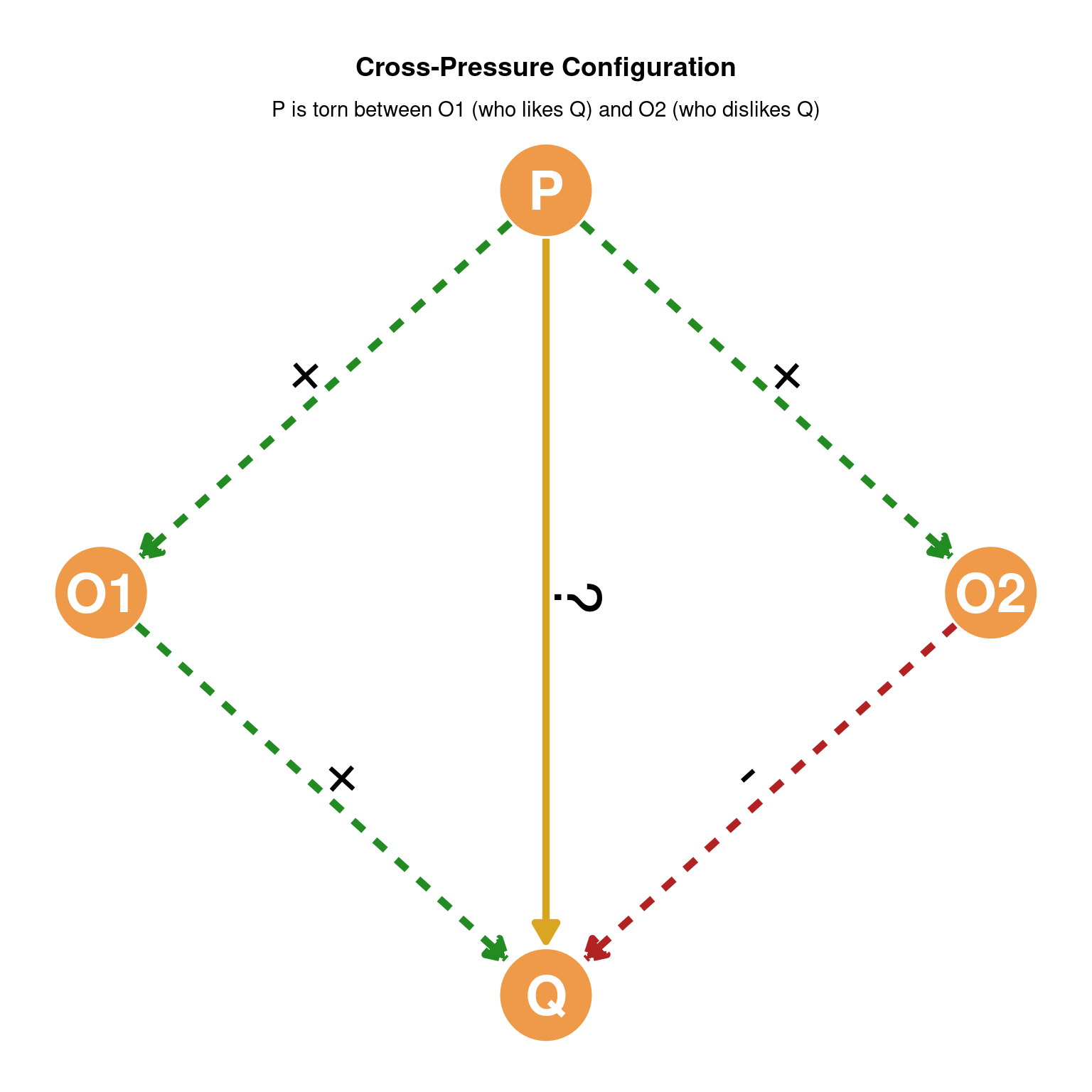
Balance theory also tells us that unbalanced, tension-filled configurations naturally tend to transition toward balanced configurations. To eliminate cross-pressure, achieve balance, and resolve your ambivalence, you would need to alter the network’s configuration of valenced ties. One way to do this is to change your attitude toward either Friend O1 or Friend O2, potentially distancing yourself from one of them, so their conflicting opinion no longer pressures you. Alternatively, you could try to convince either Friend O1 or Friend O2 to change their own attitude toward Taylor so that both of your friends are finally in agreement. By shifting these underlying sentiments, you remove the cross-pressure and restore a comfortable equilibrium to your social circle
Another common example of cross-pressure today pertains to politics. For instance, many people (P) have family members (O1 and O2) with opposite attitudes to one of the major political parties (Q), which creates tension for P (imagine that your brother loves the democrats but your sister hates them). This is the same configuration of triadic sentiments depicted in Figure fig-cross but with Q being a non-personal object (a political party). Here, once again, balance theory predicts that, as long as this configuration remains, your attitude towards the democrats will be ambivalent, combining both positive and negative sentiments, and moving you towards the dreaded moderate “middle,” or perhaps worse, making you an “independent” with no strong partisan affiliation.